Taxi Dispatch System: When Does a Small Operator Actually Need One?
Dispatch software pays off when allocating jobs is a daily headache. Before that point, a good booking system plus a simple driver workflow is often enough.
When operators ask each other for software recommendations, the setup they describe is nearly always the same: bookings coming in by phone, WhatsApp and email, a spreadsheet or diary to keep track, and a lot of messages to drivers. What they want is “bookings and dispatch in one place”.
A taxi dispatch system can give you that. But it’s worth being clear on what dispatch software is for, because it’s often bought to fix the wrong problem.
What a taxi dispatch system actually does
Dispatch software runs the operation once a booking exists. Typically:
- A dispatcher screen showing all jobs and drivers
- Automatic or manual job allocation
- A driver app where jobs arrive, get accepted and get updated
- Live job status (on the way, arrived, passenger on board, complete)
- Account customers, invoicing and reporting
Some systems also include a passenger app and a web booking widget.
What it doesn't do on its own
It doesn’t bring bookings in. If customers can’t find you, or can’t get a price easily, the best dispatch console in the world just organises a quiet diary very neatly.
This matters because a lot of smaller firms say “we need dispatch software” when what they really mean is “we’re losing bookings because it’s all manual”. Those are two different problems.
Dispatch software or a better booking setup? We'll give you an honest answer.
Signs you need a dispatch system
- Deciding which driver takes which job takes up hours every day
- Jobs get missed, double-booked or forgotten
- Drivers ring or message the office all day for pick-up details
- You have account customers who need monthly invoices and booking reports
- Someone in the business is effectively a full-time dispatcher already
If three or more of those are true, dispatch software is probably overdue.
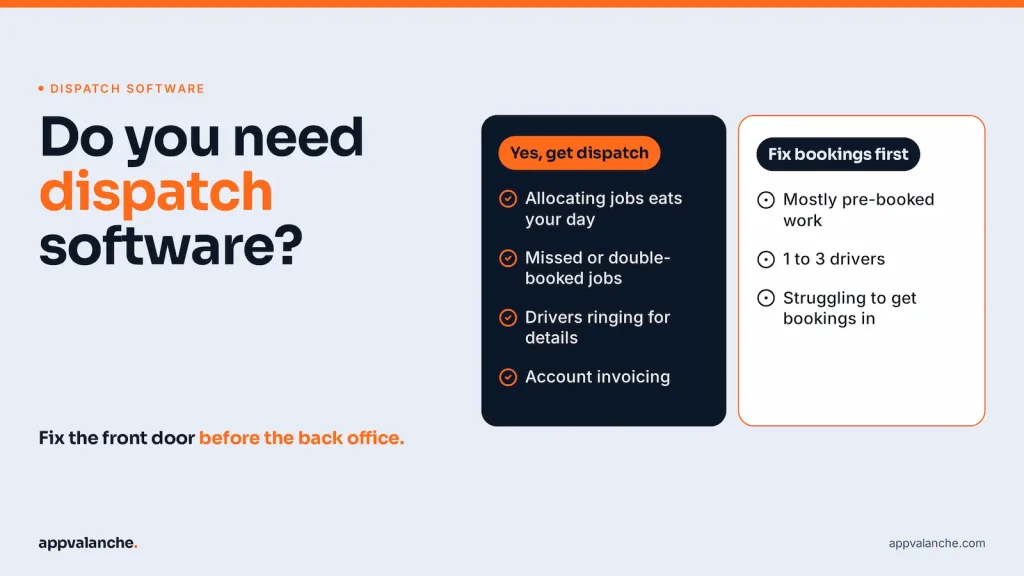
- ✓Allocating jobs eats your day
- ✓Missed or double-booked jobs
- ✓Drivers ringing for details
- ✓Account invoicing every month
- •Mostly pre-booked work
- •1 to 3 drivers
- •Evenings spent quoting prices
Signs you probably don't need one yet
- Most of your work is pre-booked days ahead (airport runs, weddings, corporate)
- You have one to three drivers who know the routine
- Your evenings are spent replying to price requests, not allocating jobs
- You’d struggle to name what a dispatcher screen would save you each week
In that case the bigger win is usually on the booking side: instant quotes, online booking and payment, automatic confirmations.
What it costs
Pricing varies a lot. Third-party UK comparisons published in 2026 list:
- Established platforms charging a few pounds per driver per week, with setup fees from around £1,200 to £5,000 and sometimes multi-year contracts
- Lighter systems charging per vehicle per month with free trials and no long contract
- Pay-as-you-go options charging per completed job
Always confirm current pricing directly with the supplier, and ask about contract length and what happens to your data if you leave.
How dispatch software is usually priced
| Model | How it works | Watch out for |
|---|---|---|
| Per driver per week | A fee for each active driver | Setup fees and contract length |
| Per vehicle per month | A fee for each active vehicle | Extras like branded apps |
| Per completed job | Pay as you go | Costs rising as you grow |
Source: ExpertSure UK taxi dispatch software comparison, 2026, and suppliers' own sites. Prices change, so confirm directly with each supplier.
Questions to ask before you sign up
- Can customers book online from my own website, or only through your app?
- Is there a setup fee, and what’s the minimum contract?
- How is pricing calculated: per driver, per vehicle or per job?
- Does the driver app work on the phones my drivers already have?
- Can I export my customers and booking history if I leave?
- Who do I call when something breaks on a Saturday night?
Got a quick question about your own website?
Send Petr a WhatsApp. No forms, no sales script, just a straight answer.
The order that usually works
For most chauffeur and private hire firms we work with, the sensible order is:
- A website that ranks for the searches your customers make
- A booking system with instant quotes and payment on that website
- Dispatch software once allocation becomes the bottleneck
Getting the order wrong means paying for the back office before the front door works.
Steps 1 and 2 are where we usually help: a website built to rank and a chauffeur and taxi booking system on top of it.
Common questions
What's the difference between booking software and dispatch software?
Booking software handles the customer side: price, booking, payment and confirmation. Dispatch software handles the operation: allocating jobs to drivers, driver apps, job status and invoicing. Some systems do both.
Can a one-car chauffeur firm use dispatch software?
It can, but it’s rarely worth it. With one or two cars you’re usually the dispatcher. A booking system with instant quotes and automatic confirmations saves far more time at that size.
Do drivers need a special phone for a driver app?
Most driver apps run on ordinary Android and iOS phones with GPS and mobile data. Check the supplier’s requirements and test the app on your drivers’ actual phones before committing.
Services related to this post
Want a second pair of eyes on your website?
Not sure whether you need dispatch software or a better booking setup? Send us a message and we'll tell you honestly.
Websites, booking systems and SEO for chauffeur and taxi companies. Based in Cardiff.